


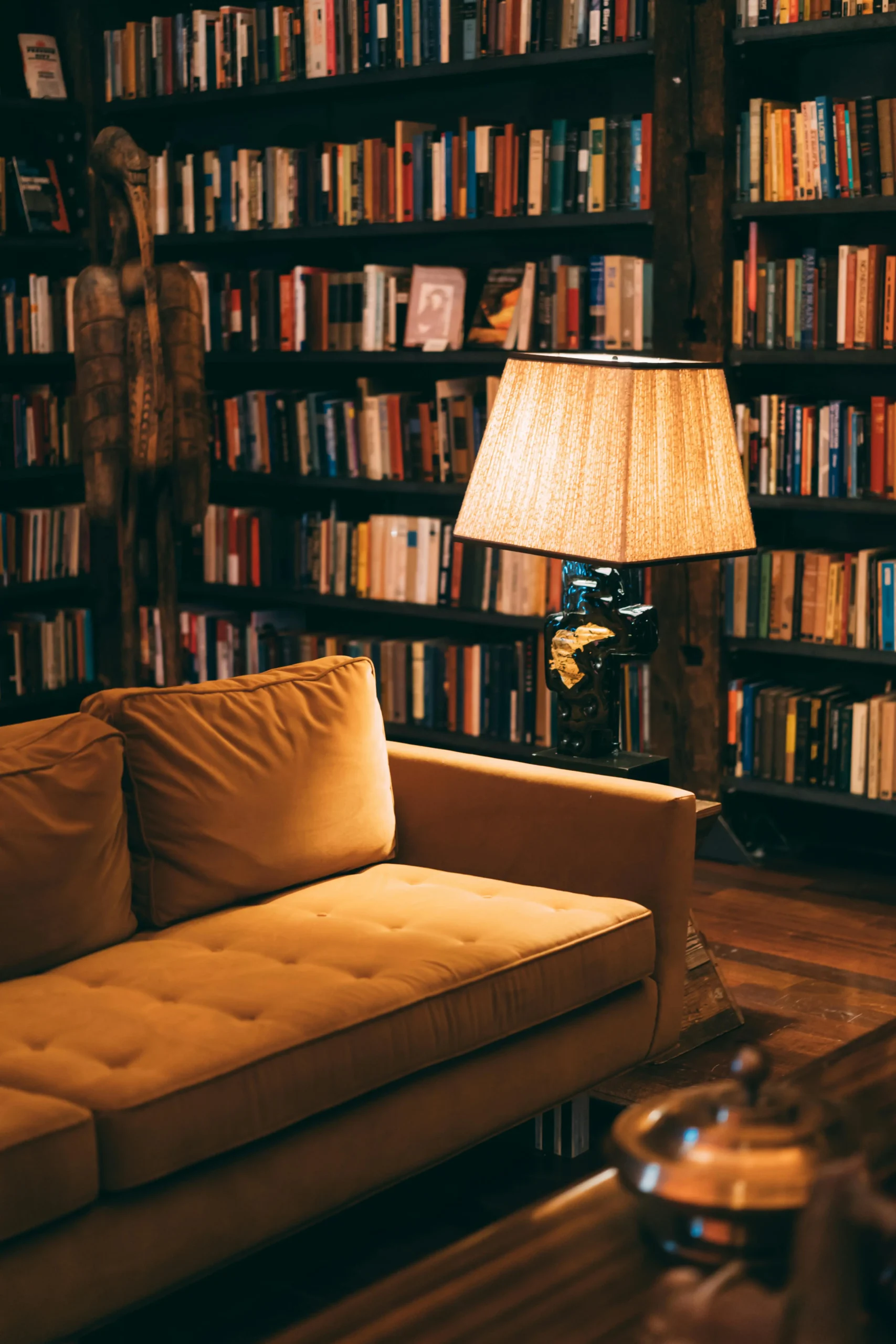
Have you ever thought why your mind adjusts differently to certain places the moment you enter?
Take a quiet library, for example. You step in from a busy street where people conduct animated phone calls about things that probably felt urgent fifteen minutes ago and will be forgotten by dinner.
Then the door closes behind you. Your footsteps soften and conversations shrink to whispers. Even your thoughts seem to slow down as if they’ve noticed the atmosphere and decided it might be rude to rush around too much in a place like this.
The room “has done something” to your mind.
We imagine thinking as a purely internal activity, that happens inside the skull, independent of the outside world. A theatre where ideas get born and vanish while the environment stays out of the way.
But the mind doesn’t really work like that. The spaces we inhabit quietly shape the rhythm of our thoughts. Some rooms invite attention and others scatter it.
You can test this easily.
Try reading a classic in a room where five screens are glowing, messages arrive every few seconds, and someone nearby is watching short videos at a volume that is specifically calibrated to irritate the human nervous system.
It can be done, technically. But your attention behaves like a restless animal that can’t stay still.
Now imagine something else.
A quiet desk. A lamp casting a warm circle of light across the page. The rest of the room dim and calm. Perhaps a few books stacked nearby, their spines leaning against one another like old companions waiting their turn.
Suddenly reading feels different. The mind settles and every paragraph receives your full attention. A sentence lingers longer than usual and thoughts begin forming with a slower, steadier rhythm.
Nothing dramatic has happened apart that the atmosphere has changed. And yet the quality of thinking has changed with it.
Many thinkers throughout history have acknowledged it. They treated the environment as part of the intellectual process.
Monasteries, for example, built entire architectural worlds around the idea of quiet attention. Long stone corridors. Small reading rooms. Libraries where the air itself seemed to carry a kind of stillness. Silence was considered an ally of thought.
A monk reading in such a place was entering a space carefully arranged to protect the fragile act of reflection.
Writers have often been just as particular about their surroundings. Look at photographs of old studies and you will notice a pattern. The desk is rarely placed randomly. Light enters from a certain direction. Books sit within reach. The chair, the window, the placement of objects, all of it forms a small ecosystem for thinking.
Virginia Woolf wrote about the necessity of a room of one’s own as a condition for serious thought. Anyone who has tried to read or write while being interrupted every seven minutes understands exactly what she meant.
Philosophers, too, have often withdrawn from the bustle of ordinary life to think more clearly. Descartes preferred quiet rooms warmed by a stove. Nietzsche walked through mountains because long wandering paths allowed ideas to unfold at a pace the city could not tolerate.
Thinking requires an atmosphere. While modern life, unfortunately, has developed a different one.
Walk into many homes in the evening and you’ll notice a peculiar glow filling the room. Screens lighting faces from below like small electric campfires. Conversations half happening while people glance repeatedly at whatever new message has been received.
Phones have a remarkable ability to scatter attention. You open the device to check one thing. Ten minutes later you are wandering through an endless corridor of opinions you never intended to encounter.
Then you look up and realise you haven’t really thought about anything in particular, for quite some time. You’ve kept the mind busy but not thoughtful at all.
There is a subtle difference between stimulation and reflection.
The former produces movement and the later produces depth. And the atmosphere surrounding many of us now leans heavily toward movement. It is not surprising that people sometimes say they struggle to concentrate on books.
The problem is rarely the book. More often it is the room.
A nice book naturally wants the mind to slow down. It invites you into a conversation that unfolds gradually across hundreds of pages. If the surrounding environment is full of small explosions of distraction, the mind never quite settles into that conversation. Reading becomes shallow and thought skims along the surface.
And yet the moment you enter a more thoughtful atmosphere, the experience changes.
You may have felt it when stepping into a large library. Tall shelves rising toward the ceiling. Rows of books stretching into quiet corners. The faint sound of someone turning a page somewhere behind you. Even the air seems different in such places.
There is a calm expectation that thinking might happen here.
People lower their voices without being told. Footsteps become careful. A quiet concentration spreads through the room.
It is amusing how quickly the human mind responds to these cues. The same person who felt scattered ten minutes earlier suddenly finds it easier to read a difficult paragraph.
The room has gently arranged the mind. Private reading spaces can produce a similar effect, even on a smaller scale.
Light plays a curious role here. Bright screens tend to pull attention outward, scattering it across whatever is flashing or moving. While lamp light narrows the visual field. The page becomes the centre of the world for a while. The rest of the room fades away. Inside that quiet circle of light, the mind can wander through ideas without being tugged away every few seconds.
Reading late at night often carries a particular calm. The house has grown quiet. Outside the window the city has slowed to a distant murmur. You sit with a book while the rest of the world seems temporarily paused.
There is something intimate about that moment. A writer from another century speaks through the page while you sit alone in the dark, listening carefully. It feels less like consuming information and more like meeting someone.
Atmosphere does not merely decorate intellectual life. It shapes it!
The spaces we inhabit gently guide the movement of our minds. A room full of interruption produces one kind of thinking. A room that welcomes silence produces another. Over time these small influences accumulate. They determine how often we encounter certain kinds of ideas. How long we stay with them. Whether our thinking remains restless or becomes more patient.
A mind that regularly enters spaces designed for reflection begins to think differently. It slows and listens while allowing ideas to unfold instead of rushing past them.
Entire intellectual lives have quietly formed in places like this. Which makes one wonder about the rooms we inhabit today.
Because somewhere in those rooms, on a desk, beside a chair, under a lamp, the atmosphere of our thinking is being arranged.
— Nicky
Founder, clasNic Pages